What is an Index Fund in India? A Complete Beginner's Guide
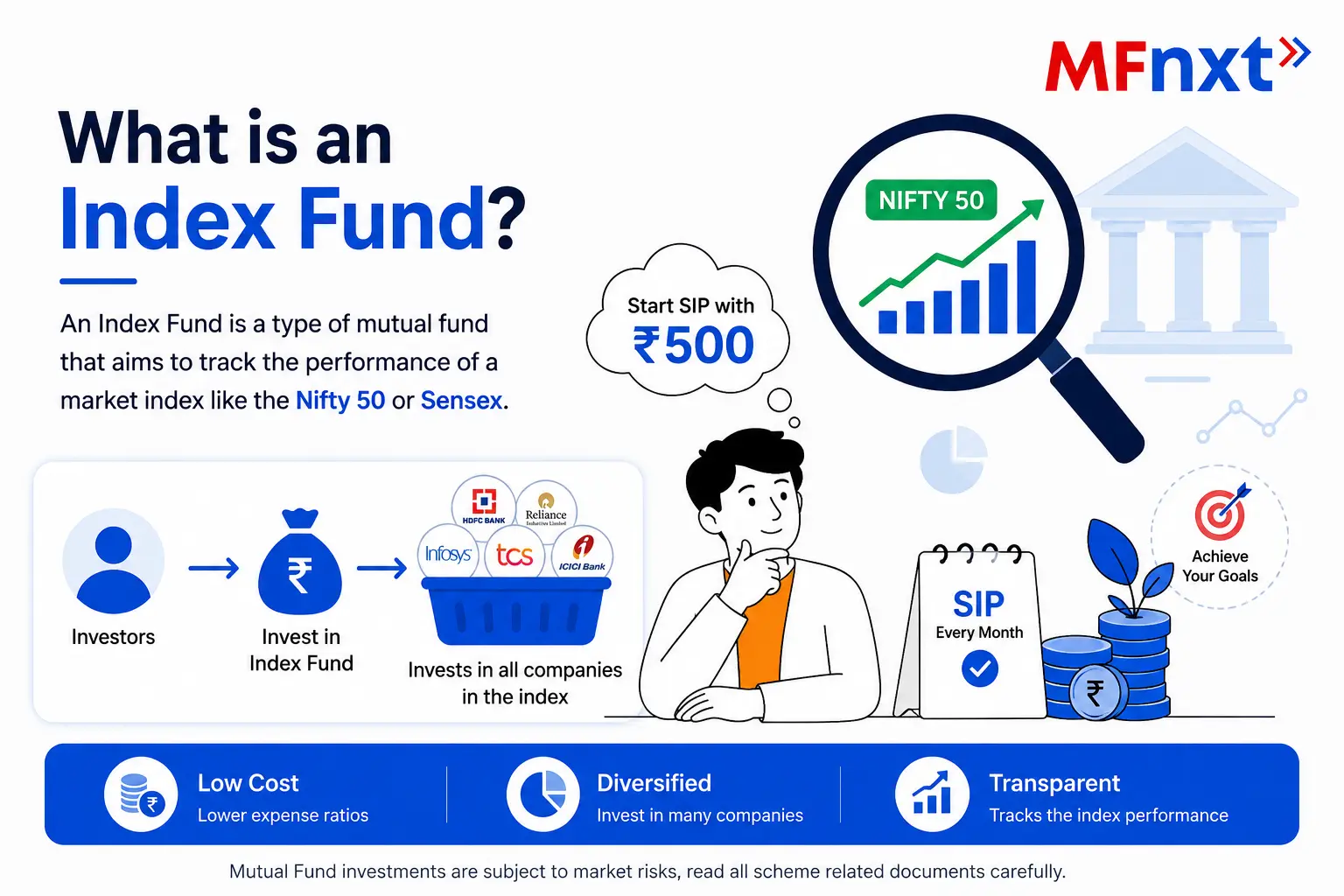
In simple terms: An Index Fund is a mutual fund that aims to replicate the performance of a specified market index, such as the Nifty 50 or BSE Sensex, rather than trying to outperform the benchmark through active stock selection.
Investing in the stock market can seem complicated when you're just getting started.
With hundreds of mutual funds, thousands of listed companies, and constantly changing market conditions, choosing where to invest may feel overwhelming.
One investment option that has gained significant attention in recent years is the Index Fund.
Rather than trying to predict which stocks will perform best, an index fund follows a simple approach—it aims to track the performance of a market index.
Whether you're planning to invest through a Systematic Investment Plan (SIP) or a lump sum amount, understanding how index funds work is an important first step in learning about passive investing.
In this guide, we'll explain what index funds are, how they work in India, their potential benefits and risks, the different types available, and the factors investors commonly evaluate before investing.
Quick Summary
- 1. Index Funds are mutual funds that aim to track the performance of a benchmark index such as the Nifty 50 or BSE Sensex.
- 2. They follow a passive investment strategy instead of actively selecting stocks.
- 3. Index Funds generally have lower expense ratios than many actively managed mutual funds because they follow a passive investment strategy.
- 4. They provide diversification by investing in multiple companies through a single mutual fund.
- 5. Like all equity mutual funds, Index Funds are subject to market risk and their value may fluctuate.
- 6. Investors can invest through SIPs or lump sum investments depending on their financial goals and preferences.
- 7. Understanding the benchmark index, expense ratio, tracking error and investment objective is important before investing.
What You'll Learn
- 1. What an Index Fund is
- 2. How Index Funds work
- 3. How passive investing differs from active investing
- 4. The different types of Index Funds available in India
- 5. Potential benefits and risks of Index Funds
- 6. How to compare Index Funds
- 7. Who may consider Index Funds based on their investment objectives
- 8. Common mistakes investors should avoid
18 May 2026
14 min read
This guide explains index funds in simple terms, including how they work, their potential benefits, risks, costs and factors investors may consider before investing.
What is an Index Fund?
An Index Fund is a type of mutual fund that aims to replicate the performance of a specific benchmark index instead of trying to outperform it.
Unlike actively managed mutual funds, where a fund manager selects stocks based on research and market views, an index fund follows a passive investment strategy.
It invests in the same companies that make up the benchmark index and generally maintains a similar allocation.
For example, if an index fund tracks the Nifty 50 Index, it will invest in the companies that are part of the Nifty 50 and adjust its portfolio when the index composition changes.
The objective of an index fund is not to generate returns higher than the benchmark, but to closely match the performance of the index it tracks, after accounting for expenses and tracking differences.
Because index funds follow a predefined benchmark, they are often viewed as a straightforward way to gain diversified exposure to the equity market through a single mutual fund investment.
If you're just getting started with passive investing, read our Beginner's Guide to Index Funds in India.
What is a Stock Market Index?
Before understanding index funds, it is important to understand what a stock market index is.
A stock market index is a group of selected companies that represents the performance of a particular segment of the market.
Think of an index as a market performance indicator. Instead of tracking thousands of listed companies individually, an index provides a snapshot of how a group of companies is performing.
Some of the commonly followed indices in India include:
| Index | Represents |
|---|---|
| Nifty 50 | 50 large companies listed on the National Stock Exchange (NSE) |
| Nifty Next 50 | The next 50 companies after the Nifty 50 based on index methodology |
| Nifty 100 | Combined representation of the Nifty 50 and Nifty Next 50 |
| BSE Sensex | 30 large companies listed on the Bombay Stock Exchange (BSE) |
| Nifty Midcap 150 | Mid-sized companies |
| Nifty Smallcap 250 | Smaller listed companies |
Each index follows a defined methodology for selecting and weighting companies. These indices may be periodically reviewed and rebalanced by the index provider.
Index funds use these benchmark indices as their investment reference.
Looking for Index Funds?
You are in the right place. We have created investment baskets for you to choose from, based on your financial goals.
Start Your Investing JourneyHow Do Index Funds Work?
An index fund aims to mirror the composition of its benchmark index.
For example, if a benchmark index allocates a higher weight to one company and a lower weight to another, the index fund generally follows a similar allocation.
When the index provider adds or removes companies from the benchmark, the fund correspondingly adjusts its portfolio to continue tracking the index.
The fund manager's primary responsibility is not to select stocks based on market predictions, but to ensure that the portfolio closely reflects the benchmark while managing operational aspects such as rebalancing, liquidity, and tracking efficiency.
Because of this approach, the performance of an Index Fund is generally expected to be close to that of its benchmark index, although differences may arise due to expenses and other factors.
Learn more about Tracking Error and Tracking Difference.
Example
Suppose an index consists of the following companies:
| Company | Weight in Index |
|---|---|
| Company A | 40% |
| Company B | 30% |
| Company C | 20% |
| Company D | 10% |
An index fund tracking this benchmark would generally aim to maintain a similar allocation.
If the benchmark changes during its scheduled review, the fund adjusts its holdings accordingly.
This systematic approach helps the fund stay aligned with the benchmark over time.
What is Passive Investing?
Passive investing is an investment approach that aims to track the performance of a market index rather than actively selecting individual stocks.
Instead of trying to identify companies that may outperform the market, passive investing follows a predefined benchmark and seeks to replicate its performance as closely as possible.
Index funds are among the most common examples of passive investment products.
Many investors choose passive investing because it offers:
- 1. A rules-based investment approach
- 2. Broad diversification across multiple companies
- 3. Lower portfolio turnover
- 4. Generally lower expense ratios compared with many actively managed equity funds
- 5. Simplicity for long-term investing.
However, passive investing does not eliminate market risk. Since index funds move in line with the benchmark they track, the value of investments may rise or fall depending on overall market conditions.
Benefits of Index Funds
Index Funds have become increasingly popular among investors because they provide a simple way to participate in the stock market.
While every investment has its own advantages and risks, Index Funds are often chosen for their transparency, diversification, and relatively lower costs.
Here are some of the commonly discussed benefits of Index Funds.
1. Diversification Through a Single Investment
One of the key advantages of an Index Fund is diversification.
Instead of purchasing shares of individual companies one by one, an Index Fund invests in all (or substantially all) of the companies that form part of a particular benchmark index.
For example, a Nifty 50 Index Fund provides exposure to 50 large companies across multiple sectors such as banking, information technology, automobiles, healthcare, FMCG, energy, and financial services.
Diversification can help reduce the impact that the performance of a single company may have on an investment portfolio. However, it does not eliminate market risk.
2. Passive Investment Strategy
Unlike actively managed mutual funds, Index Funds do not attempt to identify stocks that may outperform the market.
Instead, they follow a predefined benchmark index.
Because investment decisions are driven by the benchmark methodology rather than individual stock selection, passive investing offers a disciplined and systematic approach.
3. Lower Expense Ratios
Since Index Funds aim to replicate a benchmark instead of actively researching and selecting stocks, their operating costs are often lower than many actively managed equity mutual funds.
Since expenses are charged to the scheme, they can contribute to the difference between the fund's return and the return of its benchmark.
However, investors should always compare the expense ratio of different schemes before investing.
4. Transparent Investment Portfolio
The investment objective of an Index Fund is straightforward.
Since the fund tracks a publicly available benchmark, investors can generally understand which companies the fund intends to hold.
Most Asset Management Companies (AMCs) also disclose their portfolio periodically, allowing investors to review the fund's holdings.
5. Commonly Used for Long-Term Investing
Many investors use Index Funds as part of their long-term investment strategy.
Index Funds provide exposure to the market segment represented by their benchmark.
Their performance will therefore depend largely on the performance of that underlying index, subject to expenses and tracking differences.
However, future performance cannot be predicted, and investors should be prepared for market fluctuations.
6. Reduced Emotional Decision Making
Investing in individual stocks sometimes encourages frequent buying and selling based on short-term market movements.
Since Index Funds simply follow a benchmark, investors often focus more on long-term investing rather than reacting to daily market volatility.
Benefits at a Glance
| Benefit | Explanation |
|---|---|
| Diversification | Exposure to multiple companies through one mutual fund |
| Passive Investing | Tracks a benchmark instead of selecting stocks actively |
| Lower Costs | Generally lower expense ratios than many active funds |
| Transparency | Benchmark and portfolio are publicly available |
| Simplicity | Follows a predefined benchmark and a rules-based investment approach |
| Long-Term Focus | Often used as part of long-term investment planning |
Risks of Index Funds
Although Index Funds offer several advantages, they are not risk-free investments.
Like all equity mutual funds, their value can rise or fall depending on market conditions.
Understanding these risks is an important part of making informed investment decisions.
1. Market Risk
The biggest risk associated with Index Funds is market risk.
If the benchmark index declines because of economic events, corporate earnings, interest rate changes, or global developments, the value of the Index Fund may also decline.
Unlike fixed-income investments, there is no guarantee of returns or capital protection.
2. Tracking Error
An Index Fund aims to closely replicate its benchmark.
However, its performance may differ slightly from the benchmark because of factors such as:
- 1. Fund expenses
- 2. Cash holdings
- 3. Portfolio rebalancing
- 4. Transaction costs
- 5. Timing differences
Tracking Error measures the variability of the difference between the returns of the Index Fund and its benchmark over a specified period.
It can help investors understand how consistently the fund has historically tracked its benchmark and should be considered along with other scheme-related factors.
3. No Downside Protection
Index Funds participate in market movements.
When markets rise, the value of the investment may increase.
Similarly, when markets decline, the value of the investment may also decrease.
Because Index Funds follow the benchmark, they generally do not attempt to avoid market downturns by changing stock allocations.
4. Benchmark Concentration
Some benchmark indices may have a higher allocation toward specific sectors or companies.
As a result, an Index Fund tracking that benchmark will also have similar concentration.
Investors should understand the composition of the benchmark before investing.
5. Volatility
Equity markets can experience periods of significant volatility.
Short-term price movements are common and should not be unexpected.
Investment decisions should ideally be aligned with an investor's financial goals, investment horizon, and risk tolerance.
Risks Summary
| Risk | Description |
|---|---|
| Market Risk | Value may rise or fall with the market |
| Tracking Error | Fund performance may differ slightly from the benchmark |
| No Downside Protection | Losses are possible during market declines |
| Benchmark Concentration | Exposure depends on the benchmark composition |
| Volatility | Prices may fluctuate in the short term |
Types of Index Funds in India
Several types of Index Funds are available in India, each tracking a different benchmark.
Choosing between them depends on the investment objective, market exposure sought, and individual preferences.
Nifty 50 Index Funds
These funds aim to track the Nifty 50 Index, which represents 50 of the largest companies listed on the National Stock Exchange (NSE).
They provide exposure to large-cap companies across different sectors.
Nifty Next 50 Index Funds
These funds track the Nifty Next 50 Index, which represents 50 companies from the Nifty 100 after excluding the Nifty 50 constituents, according to the applicable index methodology.
Nifty 100 Index Funds
These funds combine exposure to both the Nifty 50 and Nifty Next 50, providing broader diversification across 100 companies.
Sensex Index Funds
These funds track the BSE Sensex, consisting of 30 large companies listed on the Bombay Stock Exchange.
Midcap Index Funds
These funds aim to replicate benchmark indices representing medium-sized listed companies.
Mid-cap indices represent a different segment of the equity market and may experience different risk and volatility characteristics compared with large-cap indices.
Small Cap Index Funds
These funds track small-cap benchmark indices
Because they invest in relatively smaller companies, they may experience greater price fluctuations compared with large-cap indices.
Want to understand how these two benchmarks differ? Read our Nifty 50 vs Nifty Next 50 comparison.
Sectoral & Thematic Index Funds
Some Index Funds track specific sectors such as:
- 1. Banking
- 2. Information Technology
- 3. Healthcare
- 4. Infrastructure
- 5. Consumption
Because they concentrate on a single sector or theme, these funds may carry higher concentration risk than diversified index funds.
International Index Funds
Certain Index Funds provide exposure to international equity markets by tracking overseas benchmark indices.
These funds may also be influenced by currency movements and global market conditions.
Comparison of Common Index Categories
| Index Category | Typical Exposure | General Characteristics |
|---|---|---|
| Nifty 50 | Large-cap companies | Large-company equity exposure |
| Nifty Next 50 | Companies outside Nifty 50 represented by the index | Different composition and volatility characteristics |
| Nifty 100 | Nifty 50 + Nifty Next 50 | Broader large-cap exposure |
| Sensex | 30 large companies | Large-company equity exposure |
| Midcap indices | Mid-sized companies | May experience higher volatility |
| Small-cap indices | Smaller companies | May experience significant volatility |
How to Evaluate an Index Fund in India?
Once an investor understands how Index Funds work, the next question is often: how can different Index Funds be compared?
It may be tempting to compare funds only on the basis of recent returns or expense ratios.
However, an Index Fund is designed to track a benchmark, so several factors may be relevant while evaluating one.
These include:
- 1. Benchmark Index
- 2. Tracking Error
- 3. Tracking Difference
- 4. Expense Ratio
- 5. Scheme Size and History
- 6. Riskometer
- 7. Scheme Investment Objective
These factors should be considered together rather than relying on any single metric.
1. Understand the Benchmark Index
The first step is understanding which index the fund is designed to track.
Different indices provide exposure to different segments of the market.
For example:
- Nifty 50 represents 50 large companies included in the index.
- Nifty Next 50 represents the next 50 companies after the Nifty 50 based on the index methodology.
- Nifty 100 provides exposure to companies represented by the Nifty 50 and Nifty Next 50.
- Midcap indices represent mid-sized companies.
- Small-cap indices represent smaller listed companies covered by the respective benchmark.
Therefore, two Index Funds tracking different benchmarks should not be compared solely on the basis of their returns.
The underlying benchmark determines the type of market exposure an investor receives.
Related Reading
Trying to understand the difference between two widely followed indices? Read our Nifty 50 vs Nifty Next 50 comparison.
2. Check Tracking Error
An Index Fund aims to replicate the performance of its benchmark, but the fund and the index may not move exactly together.
Tracking Error measures the variability of the difference between the returns of the Index Fund and its benchmark over a specified period.
Tracking Error may arise because of factors such as:
- 1. Fund expenses
- 2. Cash maintained by the scheme
- 3. Transaction costs
- 4. Portfolio rebalancing
- 5. Corporate actions
- 6. Changes in index constituents
- 7. Timing differences while buying or selling securities
Tracking Error can therefore help investors understand how consistently an Index Fund has historically tracked its benchmark.
It should, however, be considered along with other factors and should not be used as the sole basis for selecting a mutual fund scheme.
3. Understand Tracking Difference
Tracking Error and Tracking Difference are related concepts, but they are not the same.
Tracking Difference refers to the difference between the return generated by an Index Fund and the return of the benchmark it tracks over a given period.
For example, purely for illustration:
| Illustrative Example | Return |
|---|---|
| Benchmark Index | 10.00% |
| Index Fund | 9.70% |
| Difference | -0.30% |
The above numbers are only an illustration to explain the concept and do not represent the performance or expected return of any mutual fund scheme.
4. Compare the Expense Ratio
The Expense Ratio represents the expenses charged to a mutual fund scheme for managing and operating the fund, expressed as a percentage of the scheme's assets.
Index Funds generally have relatively lower expense ratios compared with many actively managed equity mutual funds because they follow a passive investment strategy.
However, expense ratios can vary between Index Fund schemes.
Since expenses are charged to the scheme, they can contribute to the difference between the fund's return and the return of its benchmark.
A lower expense ratio may reduce the cost of investing, but it should not be considered in isolation.
Investors may also consider the benchmark being tracked, tracking efficiency, investment objective, risk factors and other scheme characteristics.
5. Review Scheme Size and History
Investors may also review information such as the scheme's Assets Under Management (AUM) and operating history.
However, a larger fund size or longer history does not automatically mean that a scheme is more suitable for an investor.
Similarly, a newer or smaller Index Fund should not be judged only on the basis of its size.
These are additional data points that may be considered together with the fund's benchmark, tracking efficiency, costs and scheme-related information.
6. Check the Scheme Riskometer
Mutual fund schemes are required to display a Riskometer to help investors understand the level of risk associated with a scheme.
Instead of relying on general labels such as "safe", "moderate" or "high risk" from third-party articles, investors should refer to the latest Riskometer disclosed for the respective mutual fund scheme.
The Riskometer should be considered along with the investor's own financial goals, investment horizon and ability to tolerate market fluctuations.
Important
Index Funds are market-linked investments. Diversification does not eliminate market risk, and the value of an investment can rise or fall. Investors should refer to the latest Riskometer and scheme-related documents before investing.
7. Read the Scheme Investment Objective
Before investing, investors should understand what the mutual fund scheme is designed to do.
The scheme's investment objective explains the type of benchmark or market exposure the fund intends to provide.
Investors should refer to documents and disclosures made available by the respective Asset Management Company (AMC), including the applicable scheme-related documents.
Index Fund vs Active Mutual Fund
Index Funds and actively managed mutual funds both provide access to professionally managed investment portfolios, but their investment approaches are different.
| Feature | Index Fund | Actively Managed Fund |
|---|---|---|
| Investment Approach | Passive | Active |
| Primary Objective | Aims to replicate a specified benchmark | Managed according to the scheme's stated investment objective and strategy |
| Security Selection | Primarily determined by the benchmark | Investment decisions are made by the fund management team |
| Portfolio Changes | Primarily driven by benchmark changes and tracking requirements | Driven by fund management decisions within the scheme mandate |
| Expense Ratio | Generally relatively lower | May be higher due to active research and portfolio management |
| Performance Objective | Aims to track the benchmark, subject to expenses and tracking differences | Performance may be above or below the benchmark depending on the scheme and market conditions |
Neither investment approach is automatically better than the other.
Their objectives and portfolio management approaches are different, and actual performance can vary across schemes and market periods.
Want to understand these two investment approaches in more detail? Read our Passive vs Active Investing guide.
Index Fund vs ETF
Index Funds and Exchange Traded Funds (ETFs) may both provide passive exposure to a benchmark index, but there are important differences in how investors transact in them.
| Feature | Index Fund | ETF |
|---|---|---|
| Structure | Mutual Fund | Exchange Traded Fund |
| Transactions | Purchase/redemption takes place according to applicable mutual fund rules and NAV | Units are traded on the stock exchange |
| Price | Applicable NAV as per mutual fund rules | Market price may change during trading hours |
| Demat Account | Generally not required when investing through the mutual fund route | Generally required for exchange-based transactions |
| Liquidity | Redemptions are processed by the mutual fund subject to scheme terms | Depends on buyers, sellers and trading liquidity on the exchange |
The appropriate structure depends on factors such as how an investor prefers to transact, costs, liquidity requirements and whether the investor uses a demat and trading account.
Learn More
We have explained these differences in detail in our Index Funds vs ETFs in India guide.
Can You Invest in Index Funds Through SIP or Lump Sum?
Depending on the scheme terms, investors may invest in Index Funds through a Systematic Investment Plan (SIP) or by making a lump sum investment.
SIP Investment
A SIP allows an investor to invest a predetermined amount into a mutual fund scheme at regular intervals.
Regular investing can help investors follow a disciplined investment approach. However, a SIP does not guarantee returns or protect an investor from market losses.
Lump Sum Investment
A lump sum investment involves investing an amount into a mutual fund scheme in a single transaction.
Both SIP and lump sum are methods of investing. Neither method guarantees better returns.
The method an investor chooses may depend on factors such as available investible surplus, cash flow, investment horizon and financial objectives.
SIP Calculator
Explore how different investment amounts, assumed rates and investment periods affect an illustrative SIP calculation.
Use SIP CalculatorLump Sum Calculator
Explore illustrative calculations for a one-time investment using different assumptions and investment periods.
Use Lump Sum CalculatorCalculator Note: Calculator outputs are illustrations based on the assumptions entered by the user. They do not represent actual or guaranteed mutual fund returns.
Index Fund Evaluation Checklist
Before investing in an Index Fund, investors may consider asking the following questions:
- 1. Which benchmark does the fund track?
- 2. What market segment does that benchmark represent?
- 3. What is the scheme's investment objective?
- 4. What are the applicable expenses?
- 5. How closely has the fund tracked its benchmark?
- 6. What are the Tracking Error and Tracking Difference?
- 7. What does the latest scheme Riskometer indicate?
- 8. What risks are disclosed in the scheme-related documents?
- 9. Does the investment fit the investor's financial goals, investment horizon and risk profile?
No single metric can determine whether an Index Fund is appropriate for an investor.
Investment decisions should be based on a combination of the scheme's characteristics and the investor's individual circumstances.
Common Mistakes to Avoid When Investing in Index Funds
Index Funds follow a relatively simple investment approach, but investors can still make mistakes when selecting a benchmark or evaluating a scheme.
Understanding some of these common mistakes can help investors make more informed decisions.
1. Choosing an Index Based Only on Recent Returns
A market index that has performed strongly in the recent past may attract investor attention.
However, past performance does not guarantee future performance. Different market segments can perform differently across market cycles.
Instead of looking only at historical returns, investors should understand what the underlying index represents, its composition and the risks associated with that market segment.
2. Assuming All Index Funds Are the Same
The term "Index Fund" describes an investment approach, but different Index Funds can provide very different market exposure.
For example, a Nifty 50 Index Fund and a Small-cap Index Fund both follow passive strategies, but they track different benchmarks and therefore have different portfolio characteristics and risk profiles.
Even two Index Funds tracking the same benchmark may differ in their expense ratios, tracking efficiency, scheme size and other operational factors.
3. Looking Only at the Expense Ratio
Cost is an important consideration when evaluating an Index Fund, but the lowest expense ratio does not automatically make a scheme appropriate for every investor.
Investors may also consider factors such as:
- 1. Benchmark Index
- 2. Tracking Error
- 3. Tracking Difference
- 4. Scheme Investment Objective
- 5. Riskometer
- 6. Other scheme-related information
4. Ignoring Tracking Efficiency
An Index Fund is designed to track a benchmark. Therefore, understanding how closely the scheme has historically tracked that benchmark can be useful.
Tracking Error and Tracking Difference provide different information about the relationship between the fund's performance and its benchmark.
These metrics should be evaluated together with other scheme characteristics rather than being used as standalone selection criteria.
5. Assuming Index Funds Cannot Lose Money
Index Funds are market-linked investments.
If the underlying benchmark declines, the value of the Index Fund can also decline.
Diversification across several companies may reduce company-specific concentration compared with holding a single stock, but it does not eliminate overall market risk.
6. Investing Without Understanding the Benchmark
Before investing in an Index Fund, it is important to understand the index being tracked.
Investors may consider questions such as:
- 1. Which companies are represented by the index?
- 2. Which market-cap segment does it represent?
- 3. How are companies selected?
- 4. How are securities weighted?
- 5. Is the index concentrated in particular companies or sectors?
Understanding the benchmark can provide a clearer picture of the market exposure an Index Fund is designed to provide.
Related Reading
If you're comparing two commonly followed large-cap indices, read our Nifty 50 vs Nifty Next 50 guide.
7. Investing Without Considering Overall Asset Allocation
Investing in several Index Funds does not necessarily mean an investor has a well-diversified overall portfolio.
Different indices may contain overlapping companies or provide similar market exposure.
Investors should therefore consider their overall asset allocation, financial objectives, investment horizon and risk profile rather than evaluating each investment in isolation.
8. Reacting to Short-Term Market Movements
Equity markets can experience periods of volatility.
Making frequent investment decisions solely in response to short-term market movements may not be consistent with an investor's original financial plan.
Investment decisions should ideally be based on individual financial circumstances, investment objectives and risk tolerance rather than short-term market predictions.
Index Fund Myths vs Facts
Index investing is relatively straightforward, but there are several common misconceptions about how Index Funds work.
| Myth | Fact |
|---|---|
| Index Funds cannot lose money. | Index Funds are market-linked investments. Their value can rise or fall depending on the performance of the underlying benchmark. |
| Index Funds always outperform actively managed funds. | Performance varies across schemes, benchmarks, market conditions and time periods. Neither investment approach is assured to outperform the other. |
| All Index Funds provide the same returns. | Even funds tracking the same benchmark can have differences due to expenses, tracking difference, tracking error and other operational factors. |
| Index Funds are only for beginners. | Passive investment strategies may be used by investors with different levels of investment experience depending on their objectives and preferences. |
| The Index Fund with the lowest expense ratio is automatically the best. | Expense ratio is one consideration. Benchmark exposure, tracking efficiency, scheme objective, risk factors and other relevant information may also be considered. |
| SIP investing removes market risk. | A SIP is a method of investing periodically. It does not eliminate market risk or guarantee returns. |
| More Index Funds always mean better diversification. | Different indices may have overlapping securities or similar market exposure. The overall portfolio composition should also be considered. |
Are Index Funds Suitable for Beginners?
This is one of the most common questions asked about Index Funds.
Index Funds can be relatively straightforward to understand because they follow a specified benchmark rather than relying on active stock selection.
However, being simple to understand does not mean that an Index Fund is automatically suitable for every beginner.
Before investing, an investor should understand:
- 1. The benchmark being tracked
- 2. The type of market exposure provided
- 3. The risks associated with the scheme
- 4. The investment horizon
- 5. The possibility of market fluctuations and losses
- 6. How the investment fits into the investor's overall financial objectives
An investor's experience level alone should therefore not determine whether a particular Index Fund is appropriate.
Are Index Funds Safe?
Index Funds should not be described as "safe" or "risk-free" investments.
They are market-linked mutual fund schemes, and their performance depends largely on the benchmark they track.
If the benchmark declines, the Net Asset Value (NAV) of the Index Fund may also decline.
The level and nature of risk can also differ depending on whether the fund tracks a large-cap, mid-cap, small-cap, sectoral, thematic or another type of index.
Remember
Diversification does not eliminate market risk. Investors should refer to the latest scheme Riskometer and relevant scheme-related documents to understand the risks associated with a particular mutual fund scheme.
Do Index Funds Give Guaranteed Returns?
No. Index Funds do not provide guaranteed returns.
Their performance is linked to the benchmark they track, and market indices can rise or fall.
The return generated by an Index Fund may also differ from the return of its benchmark because of expenses, tracking difference and other operational factors.
Historical returns of an index or mutual fund should not be interpreted as an assurance of future performance.
Key Takeaways
- 1. Index Funds are mutual funds that aim to replicate the performance of a specified benchmark index.
- 2. They follow a passive investment strategy rather than relying primarily on active stock selection.
- 3. Different Index Funds can provide very different market exposure depending on the benchmark they track.
- 4. Index Funds generally have relatively lower expense ratios than many actively managed equity mutual funds, but cost should not be the only comparison factor.
- 5. Tracking Error and Tracking Difference can help investors understand how closely a fund has historically followed its benchmark.
- 6. Index Funds are subject to market risk and do not provide guaranteed returns or capital protection.
- 7. Investors should review the scheme objective, benchmark, expenses, Riskometer and scheme-related documents before making an investment decision.
Conclusion: Understanding Index Funds Before Investing
Index Funds provide a relatively straightforward way to gain exposure to a market segment represented by a benchmark index.
Instead of relying primarily on active stock selection, an Index Fund follows a passive approach and aims to replicate the performance of its specified benchmark, subject to expenses and tracking differences.
However, the term "Index Fund" covers many different types of market exposure.
A fund tracking the Nifty 50 can have very different characteristics from one tracking a mid-cap, small-cap, sectoral or thematic index.
Therefore, understanding the underlying benchmark is an important part of understanding an Index Fund.
Investors may also consider factors such as Tracking Error, Tracking Difference, expense ratio, scheme objective and the latest Riskometer while evaluating a scheme.
Most importantly, Index Funds remain market-linked investments. Returns are not guaranteed, and the value of investments can rise or fall with market conditions.
Learning how the product works, understanding its risks and reviewing the relevant scheme-related documents can help investors make more informed investment decisions.
Frequently Asked Questions About Index Funds in India
1. What is an Index Fund in simple words?
An Index Fund is a mutual fund that aims to track the performance of a specified market index, such as the Nifty 50 or BSE Sensex.
Instead of actively selecting securities with the objective of outperforming the market, the fund generally invests in securities represented by its benchmark and seeks to replicate the benchmark's performance, subject to expenses and tracking differences.
2. How does an Index Fund work in India?
An Index Fund follows a specified benchmark index. The fund generally holds securities represented in that benchmark in proportions intended to help it replicate the index.
When the composition of the benchmark changes, the fund may rebalance its portfolio accordingly.
3. Are Index Funds safe?
Index Funds are not risk-free investments.
Their value is linked to the securities represented by the benchmark they track. If the underlying market or index declines, the value of the Index Fund may also decline.
Investors should refer to the latest Riskometer and scheme-related documents of the respective mutual fund scheme to understand its risks.
4. Do Index Funds provide guaranteed returns?
No. Index Funds do not provide guaranteed returns.
Their performance depends largely on the benchmark they track and prevailing market conditions. The fund's actual return may also differ from its benchmark because of expenses, tracking difference and other operational factors.
5. Are Index Funds suitable for beginners?
Index Funds can be relatively straightforward to understand because they follow a specified benchmark.
However, this does not mean that every Index Fund is suitable for every beginner. Suitability depends on factors such as the investor's financial objectives, investment horizon, risk profile and the type of benchmark being tracked.
6. Can I invest in an Index Fund through SIP?
Many Index Fund schemes allow investments through a Systematic Investment Plan (SIP), subject to the terms and minimum investment requirements of the respective scheme.
A SIP allows an investor to invest a predetermined amount periodically. SIP is a method of investing and does not guarantee returns or eliminate market risk.
You can use the MFnxt SIP Calculator to explore illustrative SIP calculations using different investment amounts, periods and assumed rates of return.
7. Can I make a lump sum investment in an Index Fund?
Many Index Fund schemes also allow lump sum investments, subject to the terms and minimum investment requirements of the respective scheme.
A lump sum investment involves investing an amount in a single transaction rather than investing periodically through a SIP.
The MFnxt Lump Sum Calculator can be used for illustrative calculations based on user-selected assumptions.
Calculator outputs are illustrations only and do not represent actual, expected or guaranteed mutual fund returns.
8. What is the difference between an Index Fund and an ETF?
Both Index Funds and Exchange Traded Funds (ETFs) may track market indices, but their transaction mechanisms are different.
Index Fund transactions generally take place at the applicable NAV according to mutual fund rules, while ETF units are bought and sold on a stock exchange at market prices.
ETFs may also involve factors such as a demat account, brokerage costs and exchange liquidity.
For a detailed comparison, read our Index Funds vs ETFs in India guide.
9. What is the difference between Nifty 50 and Nifty Next 50?
The Nifty 50 and Nifty Next 50 represent different groups of companies based on their respective index methodologies.
The Nifty 50 represents 50 companies included in that benchmark, while the Nifty Next 50 represents the next 50 companies from the Nifty 100 after excluding the Nifty 50 constituents, based on the applicable index methodology.
Because their constituents and weights differ, their performance and risk characteristics can also differ.
Read our detailed Nifty 50 vs Nifty Next 50 comparison to understand the differences.
10. What is Tracking Error in an Index Fund?
Tracking Error indicates the variability of the difference between the returns of an Index Fund and its benchmark over a specified period.
It can arise because of factors such as fund expenses, transaction costs, cash holdings, rebalancing and timing differences.
Tracking Error is one of several factors that may be considered when comparing Index Funds tracking the same benchmark.
11. What is Tracking Difference?
Tracking Difference refers to the difference between the return of an Index Fund and the return of its benchmark over a specified period.
Although Tracking Error and Tracking Difference are related, they measure different aspects of how a fund tracks its benchmark.
12. What is the Expense Ratio of an Index Fund?
The Expense Ratio represents the expenses charged to a mutual fund scheme for managing and operating the fund, expressed as a percentage of the scheme's assets.
Index Funds generally have relatively lower expense ratios than many actively managed equity mutual funds because they follow a passive investment strategy.
However, expense ratios vary across schemes and should not be considered as the only factor while evaluating an Index Fund.
13. Which Index Fund is best in India?
There is no single Index Fund that can be described as the "best" for every investor.
Different Index Funds track different benchmarks and may therefore provide different market exposure and risk characteristics.
Instead of relying on a general "best fund" ranking, investors may evaluate factors such as the benchmark index, investment objective, Tracking Error, Tracking Difference, Expense Ratio, Riskometer and other relevant scheme information.
14. Is the Nifty 50 an Index Fund?
No. The Nifty 50 is a stock market index, not a mutual fund.
A Nifty 50 Index Fund is a mutual fund scheme that aims to replicate the performance of the Nifty 50 benchmark, subject to expenses and tracking differences.
15. Are Index Funds and mutual funds the same?
An Index Fund is a type of mutual fund.
Mutual funds can follow different investment strategies. Index Funds follow a passive strategy designed to track a specified benchmark, while actively managed mutual funds involve investment decisions made by the fund management team according to the scheme's investment objective.
Want to understand the differences in more detail? Read our Index Funds vs Mutual Funds guide.
16. Can Index Funds lose money?
Yes. Index Funds are market-linked investments and can experience losses when the securities represented by their underlying benchmark decline in value.
Diversification across multiple securities does not eliminate overall market risk.
17. Is a lower Expense Ratio always better for an Index Fund?
A lower Expense Ratio means lower fund expenses, but it should not be the only factor used to evaluate an Index Fund.
Investors may also consider the benchmark, Tracking Error, Tracking Difference, investment objective, Riskometer and other scheme characteristics.
18. Should I choose an Index Fund based on past returns?
Past performance should not be treated as an assurance of future performance.
Recent returns alone may not provide enough information to understand an Index Fund. Investors should also understand the underlying benchmark, market exposure, risk characteristics, expenses and tracking efficiency.
19. Do I need a demat account to invest in an Index Fund?
A demat account is generally not required when investing in an Index Fund through the mutual fund route.
This differs from ETFs, where exchange-based transactions generally require a demat and trading account.
20. What should I check before investing in an Index Fund?
Before investing, investors may consider reviewing:
- 1. The benchmark index
- 2. The scheme's investment objective
- 3. Tracking Error
- 4. Tracking Difference
- 5. Expense Ratio
- 6. The latest Riskometer
- 7. Relevant scheme-related documents and disclosures
These factors should be considered in the context of the investor's financial objectives, investment horizon and risk profile.
Disclaimer:
This blog is published solely for educational and informational purposes.
Any references to mutual funds, investment strategies, or financial products
should not be construed as investment advice, recommendations, or return assurances.
Mutual Fund investments are subject to market risks.
Please read all scheme-related documents carefully before investing.
Related Blogs
How to choose Good Index Funds in India?
Investing in the stock market can seem daunting, especially for beginners. But with the right approach, you can make you...
Read More
Index Funds vs ETFs in India: Key Differences Explained
Investing in the stock market can seem a bit confusing, especially if you’re just starting out. But don’t worry! The...
Read More
Index Funds vs Mutual Funds: Everything You Need to Know
Investing in mutual funds and index funds is an excellent way to grow your wealth over time. But, with so many options a...
Read More
A Beginner’s Guide to Investing in Index Funds in India
Getting started with investing in India can feel confusing — with so many options, terms, and risks. But if you’re l...
Read MoreLooking for Index Funds?
You are in the right place. We have created investment baskets for you to choose from, based on your financial goals.
Start Your Investing Journey